
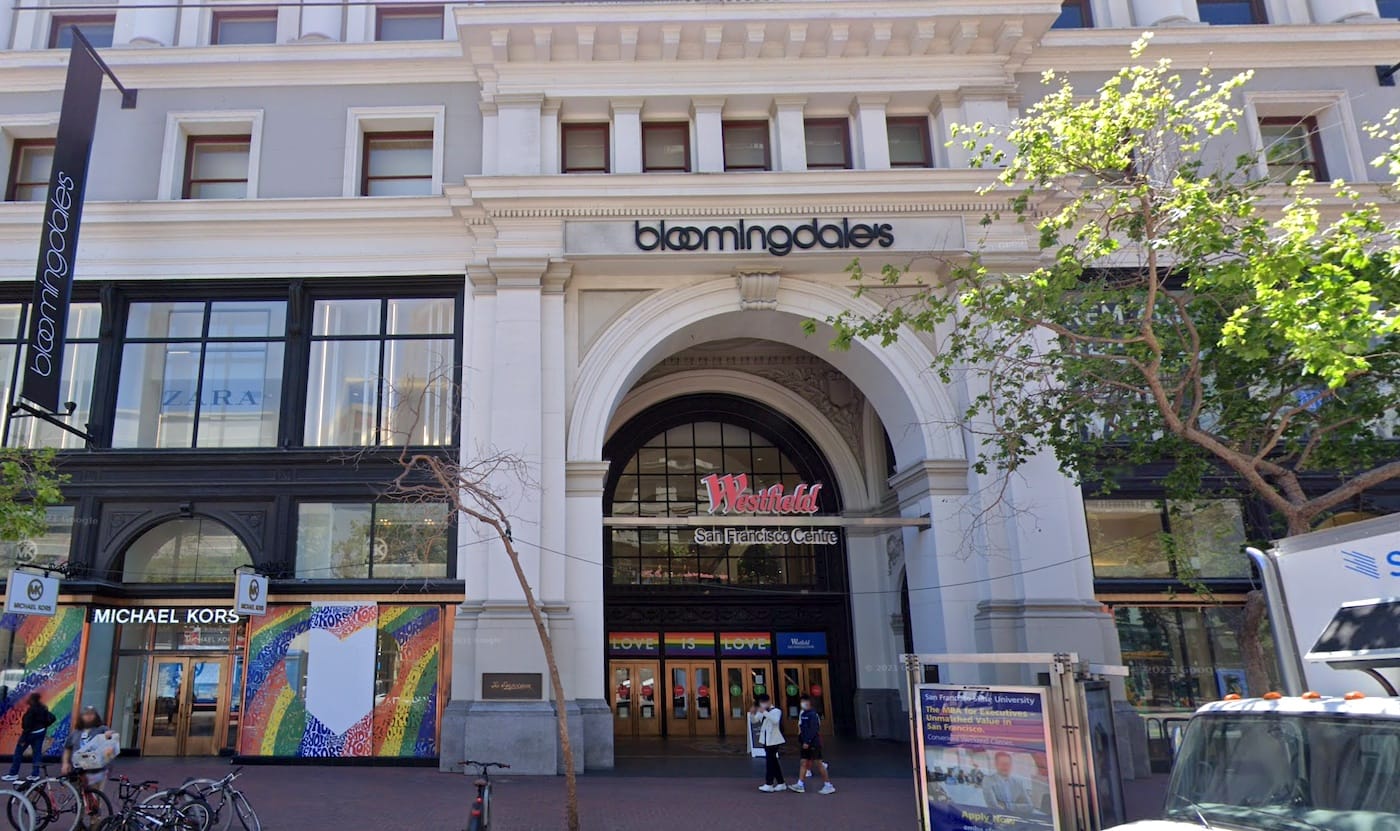
In what may be the least surprising SF real estate development of the year, someone inquired in June about permits for an AI data center at the former Bloomingdale’s site at Westfield Centre mall, a month after a local parody blog imagined a similar fate.
The saga of San Francisco’s beleaguered Westfield Centre mall continues as downtown real estate remains a hot commodity amid the AI boom. As the Chronicle reports, Maryland-based KG Growth Partners contacted the Department of Building Inspection in June on behalf of a prospective buyer, asking about permits for an AI data center at the former Bloomingdale’s site at 845 Market Street. No application has reportedly been filed for the 350,000-square-foot space.
KG CEO Jared Krieger told the Chronicle the proposal would keep the ground floor open to the public, with technical operations upstairs and in back-of-house spaces. He described the concept as an “AI-controlled living space” developed with an unnamed AI lab, potentially including a rooftop garden to grow food for a nonprofit serving people experiencing food insecurity in temporary shelters. The prospective buyer’s identity and the status of any sale remain unclear.
Back in May, local satire blog Halting Problem imagined a similar scenario, with the mall being filled with AI accelerator chips in place of its former retail tenants. In that version, the famous spiral escalator in the former Nordstrom would become a passage for data center technicians, while a small public cafe would employ a robotic barista to sell coffee and matcha while “aggressively upselling ChatGPT subscriptions.”
The real-world proposal faces substantial obstacles. The Chronicle notes that San Francisco Centre’s former Bloomingdale’s space accounts for roughly one-third of the larger mall, which has several separate ownership arrangements and a complicated ground lease with the San Francisco Unified School District. As SFist reported in July, a deal to sell the complex to Presidio Bay Ventures and Prado Group fell apart after negotiations over the ground lease failed. Although the lease was subsequently extended through 2082 with lower payments, the property returned to the market.
The building’s unusual configuration has also limited its potential uses. According to the Chronicle, its deep interior spaces and lack of natural light make a housing conversion difficult, while the city’s high office vacancy rate has undermined the economics of a conventional office redevelopment..
San Francisco’s data center moratorium could also complicate the project’s path forward, as the Board of Supervisors unanimously approved a 45-day pause on new data centers and expansions earlier this month. The pause could be extended for up to 22 months if officials find significant environmental impacts, when they would also consider permanent controls, restrictions, or a potential citywide ban.
And the data center proposal is even more unlikely to see the light of day because it would also have to abide by seven new bills signed by Governor Gavin Newsom last month, requiring operators to provide communities with more information about proposed developments while preventing them from shifting infrastructure costs onto residents.
The Chronicle reports that the proposed mall conversion would also test Mayor Daniel Lurie’s vision of a downtown where people can work, live, play, and learn, although City Hall could be receptive to a mixed-use proposal that maintains public-facing space, according to sources familiar with downtown recovery efforts.
And if the former mall can find a second life as AI infrastructure, it is not hard to imagine other underused downtown properties attracting similar interest.
Previously: Uh Oh: SF's Shuttered Downtown Mall Back on Market After Buyers Back Out


