
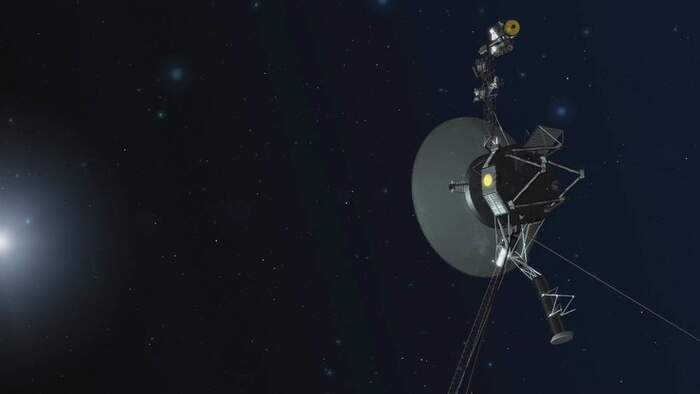
Got a flashlight? NASA wants you to point it toward the sky Tuesday night to celebrate a milestone nearly 50 years in the making.
NASA’s Voyager 1 spacecraft is about to become the first human-made object to reach a distance of one light-day from Earth, putting it more than 16 billion miles away from our planet.
To celebrate, the space agency is inviting people around the world, including those in Houston, to participate in an event called “Shine Bright for Voyager’s Light-Day” on Tuesday, Nov. 17.
The idea is simple: After sunset, grab a flashlight or phone and flash a message into the night sky using Morse code.
NASA hopes the celebration will create a symbolic wave of golden light around the planet in honor of humanity’s most distant spacecraft.
Launched on Sept. 5, 1977, Voyager 1 has spent nearly five decades traveling through space, exploring the outer planets before continuing into interstellar space.
On Wednesday, Nov. 18, at precisely 4:16:07 a.m. Central time, the spacecraft is expected to reach a distance of one light-day from Earth.
A light-day is a measurement of distance, not time. It represents how far light travels in 24 hours, approximately 16.09 billion miles.
That means a radio signal traveling at the speed of light will take an entire day to reach Voyager 1 from Earth. A response would take another 24 hours to return.
Despite traveling at nearly 38,000 mph, Voyager 1 has taken more than 49 years to reach this distance.

NASA is encouraging people to participate after sunset Tuesday, Nov. 17.
You don’t need a telescope or any special equipment. A flashlight, phone, glow stick or other light source will do.
Participants are encouraged to point their lights skyward and flash the letters “V-G-R,” the Voyager mission’s call sign, using Morse code.
Here’s how to do it:
Safety reminder: Participants should use ordinary flashlights or phone lights, not laser pointers. Never shine any light toward passing aircraft, helicopters or other people. Pointing a laser at an aircraft is federal crime.
NASA says short flashes should last less than a second, while longer flashes should last about one second. Participants should pause between letters.
Don’t know Morse code? NASA has created an automated flasher that displays the signal on your phone or tablet.
You can access the tool and find instructions on NASA’s official celebration website.
NASA is also encouraging participants to share photos and videos of their signals on social media, tagging @NASA.
The light display is symbolic. The flashes are not intended to serve as an actual communication signal to the distant spacecraft.
Voyager 1 is the farthest human-made object from Earth and one of NASA’s longest-running space missions.
Originally designed to study Jupiter and Saturn, the spacecraft provided scientists with unprecedented views of the outer solar system.
In 2012, Voyager 1 became the first spacecraft to enter interstellar space, the region beyond the protective bubble of particles and magnetic fields generated by the Sun.
Its twin, Voyager 2, followed in 2018.
Both spacecraft continue transmitting scientific data to Earth, providing researchers with information about an environment no other spacecraft has explored directly.
Voyager 1 also carries a Golden Record, a collection of sounds, images and greetings from Earth intended to represent humanity to any civilization that might someday encounter it.
And its journey is far from over.
NASA estimates Voyager 1 will pass within approximately 1.7 light-years of another star, Gliese 445, in about 40,000 years.
Voyager 2, meanwhile, is not expected to reach the one-light-day milestone until November 2035.
The celebration doesn’t end Tuesday night.
NASA’s Jet Propulsion Laboratory will host a special discussion Thursday, Nov. 19, at 11 a.m. Central time, featuring mission scientists and agency leaders.
The discussion will cover the spacecraft’s current condition, ongoing discoveries and the challenges of keeping the nearly 50-year-old probes operational.
NASA will also preview an upcoming Voyager documentary planned for release in 2027, coinciding with the mission’s 50th anniversary.
The event will be available through NASA’s live programming.
For anyone participating Tuesday night, NASA’s message is simple: Even a small light can help celebrate one of humanity’s greatest journeys into space.


